
Career Writing Method
Reinekke Lengelle & Frans Meijers 2017





Introduction
The title Lengelle and Meijers have given to their work is telling: “Playwright Meets Career Coach” with the subtitle “Writing Dialogues to Promote Awareness and Self-Direction” (Lengelle & Meijers, 2015, p. 315).
Lengelle argues that the writing method is usually used in a group setting, making it both cost effective and time effective to deliver and offer in educational institutions (Lengelle, 2017).
As you can guess, this is not a method that’s easy to pick up from reading about it. It takes time and effort to train in this method. Lengelle and Meijers propose that “writing dialogues in creative, expressive, and reflective ways can foster more awareness and self-direction” (Lengelle & Meijers, 2015, p. 315).
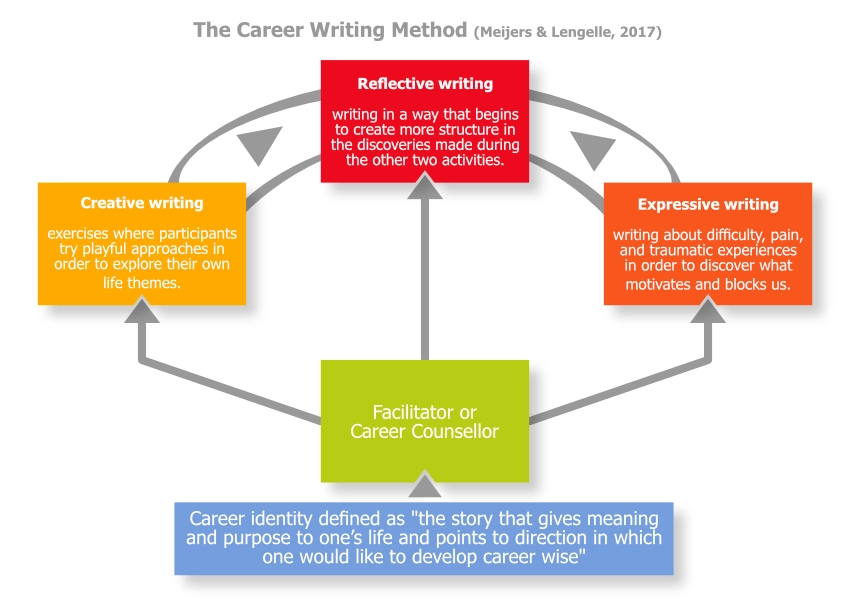
Lengelle and Meijers go on to explain that the career writing method is a response to the changing realities of work in the 21st century where the practice of matching or old narratives linked to easily identifiable career paths no longer work. (Lengelle & Meijers, 2015, p. 315). They explain this further by recognising that the world has become more individualised. At this point I would like to refer to my summary and the illustrations of Opportunity Structure Theory, especially the second part, as well as the Chaos Theory of Careers and to note the insecurity that comes with this, as Lengelle and Meijers did. The key point that Lengelle and Meijers are trying to make with this is that careers are not easily clearly ‘described’ anymore and that any matching approach is going to be challenging, if not invalid. Lengelle and Meijers call for a new approach and propose career writing as a solution to this problem. This is where to me it becomes very clear that this is a constructivist approach, with an individualised path through the myriad of career possibilities, based on the client’s personal life story and meaning within. They recognise that the self is not static but ‘dialogical’ and ever changing within a fragmented, multi-faceted world. The constant in career planning and development is no longer the labour market or the employer but the self, the individual client (Lengelle & Meijers, 2015, p. 316). Linked to that, Lengelle and Meijers observe that identity is formed by engaging in both internal and external dialogues which are a response to meeting challenges (Lengelle & Meijers, 2015, p. 316) in the client’s life and context.
Lengelle and Meijers propose that to make this an effective method in career development for the client, this can be self directed and doesn’t need to be linked to expensive one to one career counselling (Lengelle & Meijers, 2015, p. 316).
Lengelle and Meijers then introduce the concept of I-positions and see the self as not static, but tension filled and multi-voiced (Lengelle & Meijers, 2015, p. 316). To explain I-positions in detail, a concept from dialogical psychology, would lead us too far on here and if you are interested it’s a good idea to look this up further, for instance in the Handbook of Dialogical Self Theory, Hermans & Gieser, 2012, p. 14,15. For the purpose of the Writing Theory in a career context it is enough to realise that the self is dialogical, not static, and derives meaning from its internal dialogue and from that with the external context. This process is dynamic and provides the self with a sense of ‘mine’ or identity with agency.
The Career Writing Method in Practice
The Career Writing method was developed by Lengelle and Meijers “to help individuals construct a career identity using creative, expressive, and reflective types of writing and combines the field of writing for personal development with that of career counselling” (Lengelle & Meijers, 2015, p. 317). This involves the client having written conversations with their different I-positions or sub-selves within oneself or imagined others (Lengelle & Meijers, 2015, p. 317). This can be done in different ways, linked to the client’s or specific situation’s requirements.
The aim of this exercise of creating dialogue is to create meaning for the client and a sense of getting to know the different sub-selves, providing a sense of direction. Lengelle and Meijers argue that the learning process is triggered by ‘boundary experiences’ (Lengelle & Meijers, 2015, p. 317), by which she means experiences that cannot be easily resolved. Boundary experiences are potentially life changing or ‘direction changing’ experiences such as redundancies or being ‘in crisis’, but in my view also sudden positive opportunities and options where the client is finding it impossible to make decisions in the way they are normally accustomed to. Linked to this, Lengelle and Meijers state that modern career guidance should be aimed at helping people from turning their initial negative response to life’s challenges to positive, life enhancing and ‘hope giving’ stories (Lengelle & Meijers, 2015, p. 317).
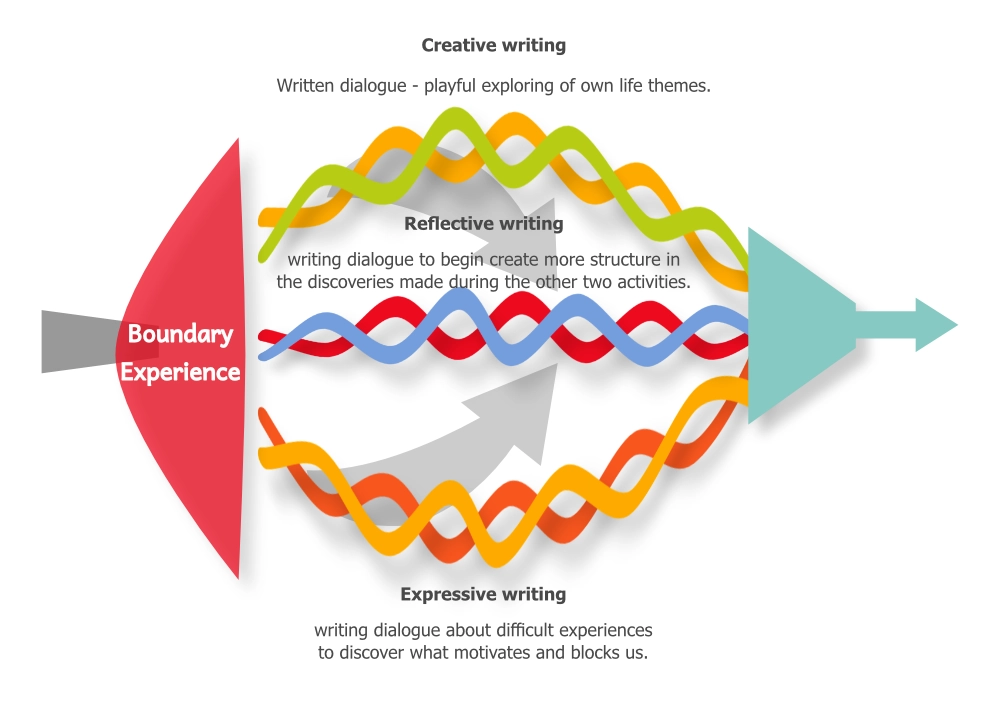
It is also widely recognised that work experience can be useful, but that having a meaningful dialogue about the experience can enhance learning from the experience through dialogue. This is generally not automatically assumed or recognised. Career writing can facilitate such learning. Writing dialogue can also challenge long established I-positions. This can cause the dialogical approach of writing in this way to instigate or generate new meaning and direction.
Lengelle and Meijers recognise that this method is often not the method of choice in a client’s ‘hour of need’ and the career guidance professional can be the person who suggests this (for the client often) new way of working with their ‘boundary experience’.
A practical way to practise the Career Writing Method
As a practical suggestions for career professionals, Lengelle and Meijers suggest looking deeper into practising this with the self. She even suggests taking a course in play or script writing, but this no doubt would be for those interested in exploring this in a lot of depth. As an exercise to practise the career writing method, she suggests (Lengelle & Meijers, 2015, p. 324):
- Writing a dialogue with your ‘child self’ and ask what childhood dreams you had and which life experiences were ‘passionate’ and memorable.
- Write a dialogue with your inner career coach/counsellor/adviser to see what s/he says. Lengelle and Meijers urge to make sure you stay in touch with your body so that responses are ‘felt’ and not mere realisations.
- Write down a career question and look around the room until your eyes rest on an object. Let the object write back to you about your career question.
If you have read quite a few summaries of career theories on marcr.net then you may notice that, no surprise, the activities may remind you a lot of Narrative Career Guidance, and also in a different way of Storyboarding, but then in written form.
What I have summarised here is only a fraction of what there is to learn about this model, even though I hope I have written a good enough summary for you to contemplate this method, and to try this out yourself. I would urge you to try and look up the different works in the references to get some examples of how this may work, but also to get a fuller understanding of where this method has come from and what it is linked to, for instance dialogical psychology.
Critique
At first I was fairly sceptical of this theory and how this can work, but by looking into the theory further, I recognise its value and potential. However, I feel that this needs to be used ‘with the right client’. In the context of my work, mainly with young people, very often this method may not be recognised as useful and (from experience) independent work by a teenage client using this method may not happen. I work in secondary schools mainly and this may sound or feel to some of my clients too much like more homework.
On the other hand, I can pinpoint some clients for whom this may be an excellent way of working towards more direction. Not surprisingly, those young people who are interested in drama, script writing and generally writing, may find this a very useful tool to try out, with a prompt and support from us.
I would also echo Lengelle and Meijer’s suggestion that this may be cost effective, in my context more cost effective in time. I sometimes lack the time to see my clients as often as I need to and this can be practised away from a career meeting with me.
However, writing dialogue generated by the different I-positions within the client will still mean that both voices of the dialogue will come from the same internal source and from within the same cognitive, social and cultural framework within that one mind. I’m not sure that the difference between the different I-positions within the client will offer enough of a challenge. The power of dialogue as a tool for opening a new or different perspective from which different outcomes can be generated is often found in being challenged by others, with a different mental, social and cultural framework. I don’t doubt creating dialogue within oneself can be effective, but I would argue that the effectiveness of this technique will be enhanced by including in some way an external voice, such as a career professional, who can challenge from a perspective that the client hasn’t considered or wouldn’t consider. This still means that this can be in a written format however. I wouldn’t suggest that an external voice always needs to be present, but I feel that at some point, that external voice can add value.
What do you think?
- In what context or with which clients would you be able to use the Career Writing method successfully?
- How would you measure success, using this method, and would you need to?
- If you practise this for yourself, what are your experiences and what are the outcomes using this method, for you?
- What are the downsides of using this method, versus ‘how you normally work’?
- What are its strengths?
Another thought – career writing and AI?
With the increasing availability and use of AI, how can the career writing method be adapted to include the use of AI? Some people already use AI for ‘counselling’ (you decide whether it really is counselling!) and have a lively dialogue with one of the online AI tools. There are serious ethical considerations to be made, however:
- adding your personal writing to servers not under your control – you don’t know what happens with what you write
- AI bias towards certain outcomes
- ‘what comes out is what has gone in’, which in some way mirrors the limit I mentioned above, of the potential limiting function of only having dialogue within the self.
- … (what else?)
Obviously, comparing this to the method Lengelle and Meijers developed, this is a fudged version of the Career Writing Method in the sense that the individual engaging in career writing in this way doesn’t have a dialogue between different I-positions anymore. But is it something to try out? If you do, post on LinkedIn what happened and whether/how it worked…
References
- Hermans, H. J. M. & Gieser, T., 2012. Handbook of Dialogical Self Theory. Cambridge: Cambridge University Press .
- Lengelle, R., 2017. Writing the Self – Career Writing. [Online]
Available at: https://writingtheself.ca/home/why-write/writing-your-career-story/
[Accessed 09/12/2025]. - Lengelle, R. & Meijers, F., 2015. Part 6; Using Dialogues to Foster Awareness and Self-Direction in Career Counselling. In: K. Maree & A. Di Fabio, eds. Exploring New Horizons in Career Counselling. Rotterdam: Sense Publishers, pp. 315-327.
Further Reading: