
Constructivist Theory
Chartrand et al., 1995; Cochran, 1997; Collin & Young, 1986; Peavy, 1992; Savickas, 1993 & 1997; Young et al. 1996; Wendy Patton & Mary McMahon 2006




Introduction
Constructivism is more of a category containing quite a few theories and theorists, but I thought I would make a page on constructivism anyway because it’s a group of theories, or a concept, quite a few people struggle with.
The general tenet of constructivism is that there is no objective truth, there are only subjective points of view or perspectives and we all build our own life around how we perceive the world around us.
Translated to career guidance or career counselling, the task of the career professional is to assist the client in finding themes in their life and to help the client extend the thread of these to the next step they take in their life.
Apologies for the weird mixed metaphor below, but I hope it illustrates the theory and… because it’s a bit ‘unusual’ it may be easier to have it stick in your mind…
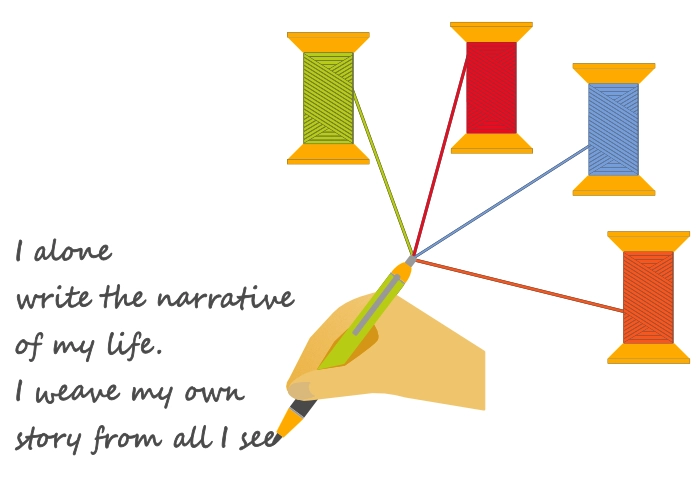
The difference with Social Learning Theory and Structuralism is that the individual is in control, whereas in social learning theory, an individual is directly influenced or ‘coloured’ through the social learning they engage in, while in structuralism, social structure is like a set of constraints within which an individual lives their life. According to constructivist theory, there is no social construct ‘out there’ and an individual uses the learning, observations, experiences in their life to construct their story, their narrative; they are the authors of their life, no one else.
As you will realise, this is as far removed from Differentialism as it’s possible to get without falling off a cliff.
The role of the practitioner
Stories, or meaning, are created by the individual, both the client and the professional. In this sense, by the client it is partly created in their interaction with the professional. Unlike Parson’s theory, the career professional is not the expert; they are the facilitator for the client writing or making their own ‘story’. They are at the same level as the client. Narrative, or meaning is created together or co-constructed. The professional is more counsellor than ‘match-maker’; they are the co-author of the client’s story.
The career counsellors help clients:
- Authorise their careers by narrating a coherent, continuous, and credible story
- Invest career with meaning by identifying themes and tensions in the story line, and
- Learn the skills needed to perform the next episode in the story (Savickas, 1993, p. 213)
Feel free to click on the thumbnails below to explore and find out more about some examples of constructivist theories:
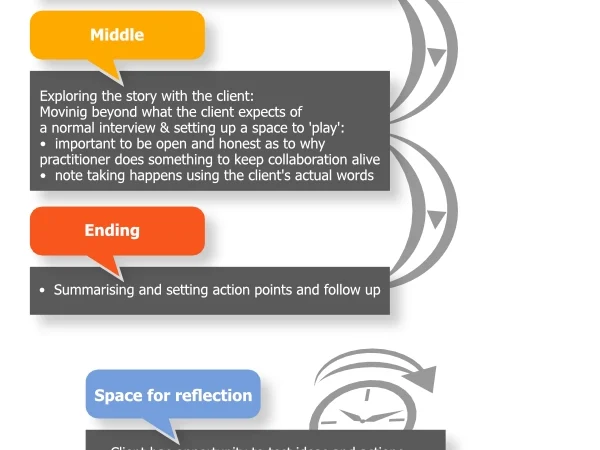
Narrative Career Counselling
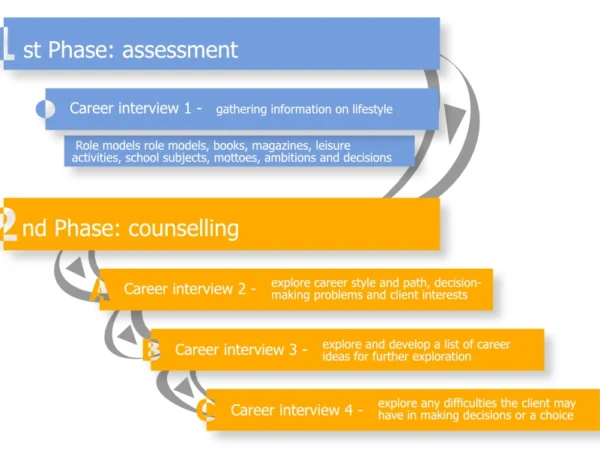
Career Construction Theory & Life Design
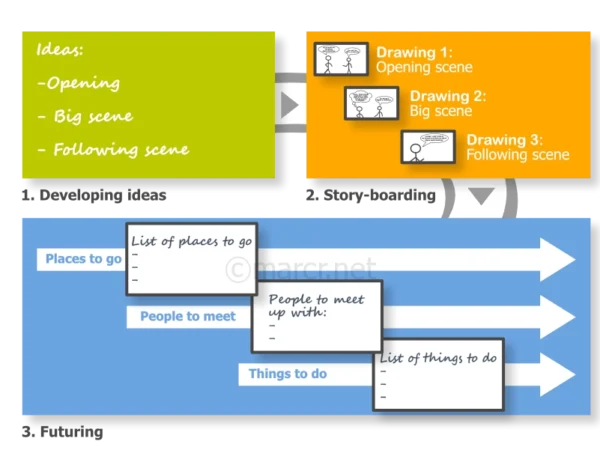
3 Step Storyboarding Model
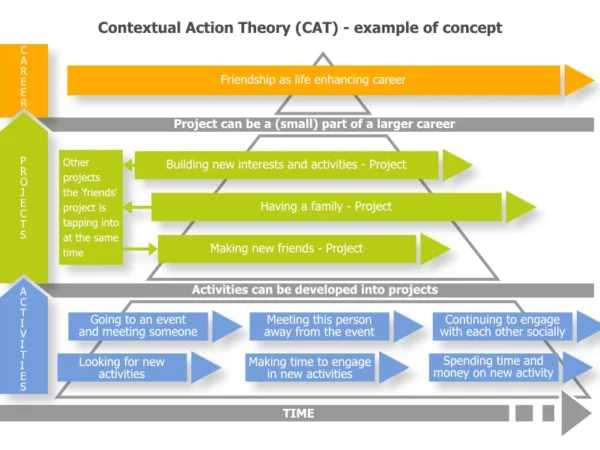
Contextual Action Theory (CAT)
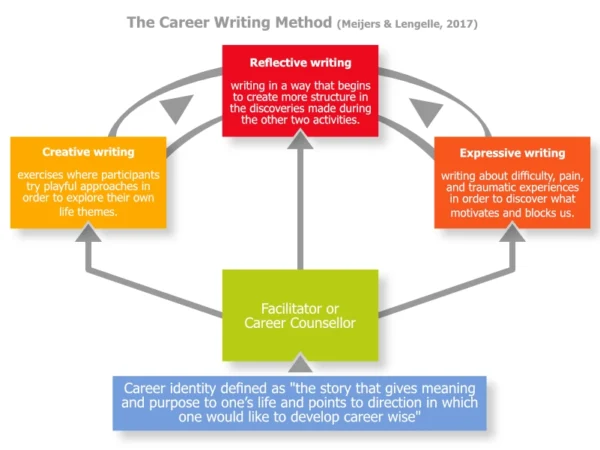
Career Writing Method
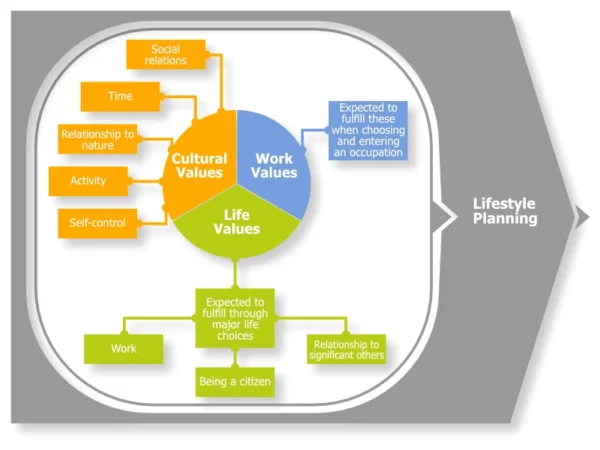
Value-based Career Decision Making

Continuous Participation Model
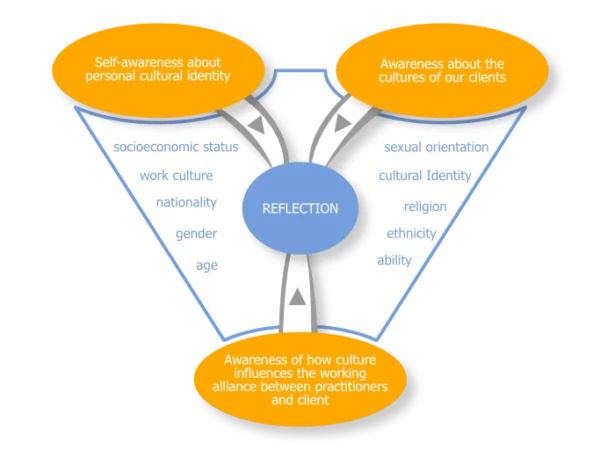
Culture Infused Career Counselling
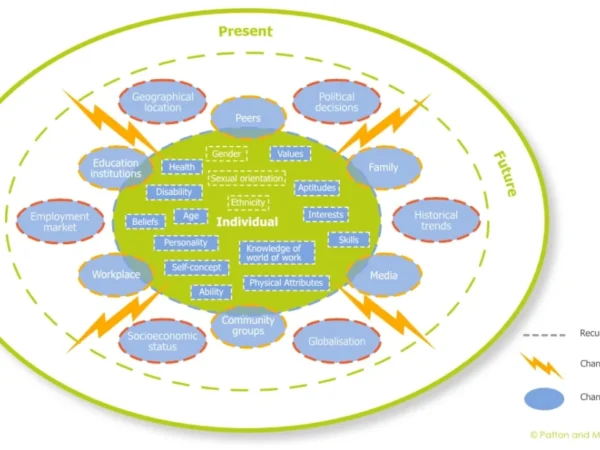
Systems Theory Framework of Career Development
General Critique
If you take constructivism, and my exploration above, literally, then the client and we would operate in a value free, bias free environment, making decisions entirely freely. However, you have hopefully realised already, this is never the case. Just like stories in books are based on the reality, the socio-cultural context, in which they are created, so too will anyone’s thinking about career planning, options and possibilities be co-created within the context in which they arise. Even the most fantastic science fiction stories, or fantasy novels, are based in the reality of the writer or story teller. There seems to be no way out of this… especially when it comes to the cultural context of the story. This is clearly visible if you look at science fiction stories decades on from when they were created. They will look dated, but also you can clearly extract signifiers of the time period in which they were created. If you want to try this out, explore one of the old (ideally the ones from the 1960s; the further away in time, the clearer they illustrate this point) Dr Who episodes on the BBC website, if still available at the time of reading this, and notice not only the old fashioned technology which is supposed to be in our future, but also the social norms of the time period during which it was filmed, a lot of which would be shocking now!
So even though the client writes their own story, it is still important to be aware of the context within which they write their story, as amongst other theories, System Theory will testify.
Does this mean that constructivism is ‘fiction’ (apologies for the pun)? I don’t think so… To take Community Interaction Theory and Social Learning Theory as examples; it provides the client with real agency vis-a-vis the perceived and relative lack of agency presented by those theories, especially Community Interaction Theory. It also shatters the relative determinism central to structural theories, especially early Opportunity Structure Theory. So you can see, career planning and career decision making, are an interesting mix between relative freedom and relative influence, negotiated through the level of awareness of us and the client and the level of agency by the client. Constructivism proposes a lot of agency; with other theories the balance is more in favour of influence, offering the client less or even no agency.
 I hope this has made constructivism clearer as a concept and approach and I would suggest, in view of what is on this page, explore a couple of the theories mentioned here and see what your idea is about them, what the strengt and weaknesses are of the theories and with that, of constructivism.
References
- Savickas, M. (1993). Career counseling in the postmodern era. Journal of Cognitive Psychotherapy: An International Quarterly, 7(3), 205-215.