
Developmental Theory – Life Span Development
Donald Super






Table of Content
Definition
This page is mainly written around his revision of his theory in 1980. Donald Super defines a career as “the combination and sequence of roles played by a person during the course of a lifetime” (Super, 1980, p.282). The life rainbow below will help you visualise the concept Super is trying to get across and the very many levels, interconnections and conflicts included in his theory. Super makes the distinction between ‘theories of occupational choice’, which at the time of the conception of Super’s model will have been all “trait and factor” style theories (see timeline on this website for more information) apart from Ginzberg, as well as ‘theories focused on career development’ of which his developmental theory is obviously one (the clue is in the name!).
Super’ rainbow visualised
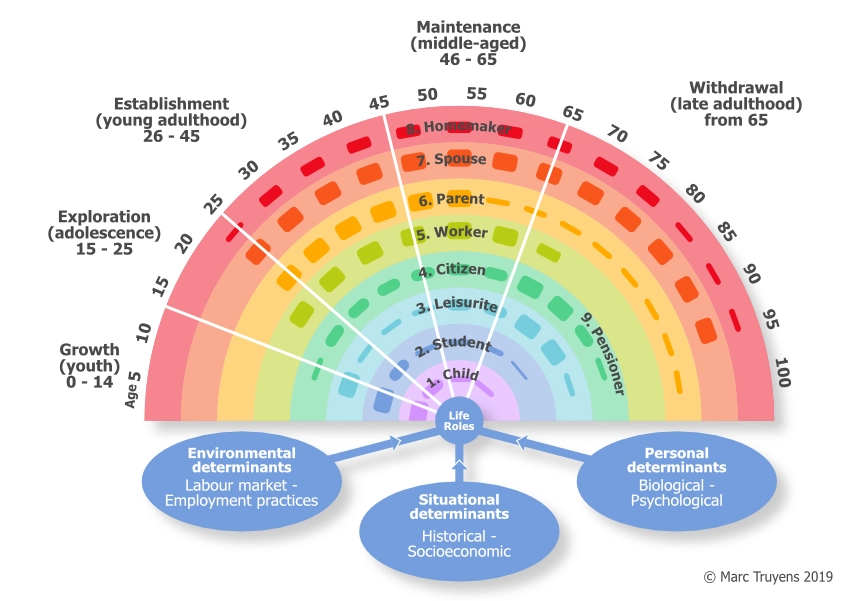
The career rainbow is based on the concept of people playing or inhabiting a number of roles as they move through life. These roles can overlap and contradict each other, prompting the necessity for decision making and compromise. Super proposes 9 main roles throughout life in 4 different principal ‘theatres’ (Super, 1980, p.283).
9 Roles
If you have a look at the rainbow above you will recognise all 9:
-
- Child – daughter or son
- Student
- Leisurite – the role of being engaged in leisure activities (or nothing at all!)
- Citizen
- Worker – including ‘non-worker’, volunteer or person who is unemployed
- Parent
- Spouse
- Home maker
- Pensioner
Super recognises that not all play all roles in life and that roles may be abandoned. He admits there may be overlap but states that the order of the roles on the rainbow generally corresponds with how these roles are generally taken up. Super also doesn’t like biological sex apsect to any of these roles, stating (maybe a bit clumsily for 21st century ears) that none of these roles are ‘sex linked’ (Super, 1980, p.284).
Super’s 4 Theatres
-
- The home
- The community
- The school – including college, university, etc…
- The workplace
Super recognises that not everyone enters all theatres and that there other theatres, such as the care home, etc… (Super, 1980, p.284). Roles and theatres interact in a variety of ways. Some roles may be played in one theatre and some may be played out in different theatres. Some theatres may encompass one role and some more than one (home working for instance). Roles may have a primary theatre they are played out in and some theatres may be the principle theatre for a role.
The term ‘role’ needs to be understood in terms of expectations by different actors and observers, as well as performance by different actors and observers (Super, 1980, p.285). Super recognises that ‘roles’ can be fluid and more multi faceted throughout an individual’s life in a variety of ways and configurations.
Linked to the representation of his theory before, pre-occupational roles such as child and student begin to influence later occupational positions and how they are met. For instance: the amount and type of schooling is a determinant of future occupational choice and position. More controversially in my view, Super claims that the first occupational position is one determinant of future occupational positions open to the individual (Super, 1980, p.286). I can agree this was more the case when Super wrote this, but I do feel there is more flexibility and fragmentation in the world of work, as well as in options for career development, education, etc… Evidence for this could be, amongst many other factors, the way the world of work allows for ‘portfolio careers’ and adult educational opportunities. This still with some limitations in the time, effort and cost required for possible retraining or a change in career direction.
Life style – life space – life cycle
Super further defines how these different roles and theatres, as well as their interaction, make up the career pattern for an individual (Super, 1980, p.288).
-
- Life style – the combination of life roles
- Life space – the sequential combination of life roles structures the life space
- Life cycle – the life space and life roles people occupy constitutes the life cycle as a time bound structure
The total structure of all of these together is the career pattern. The Life Cycle and Career Patterns encompass the waxing and waning of roles.
More practically, Super links his model of the rainbow to different decision points for every role throughout life. this brings us to the practical application of the theory.
Super’s Archway Model
To explicitly include career determinants, which the rainbow model does not do, Super expanded his theory with the Archway Model or Segmented Model, in which each segment or stone in the archway represents a determinant for career planning and management, with the more basic ones near the bottom (Super, 1994, p.67). Super’s archway represents personal or psychological determinants on the left and social or geographical determinants on the right. He also states that in this representation, the two different pillars are not completely separate from each other but that they should have a number of vectors or arrows between the different elements that influence and impact on each other. For instance family, as a social entity in the individual’s life, may influence and have an effect on the individual’s needs and values and vice versa.
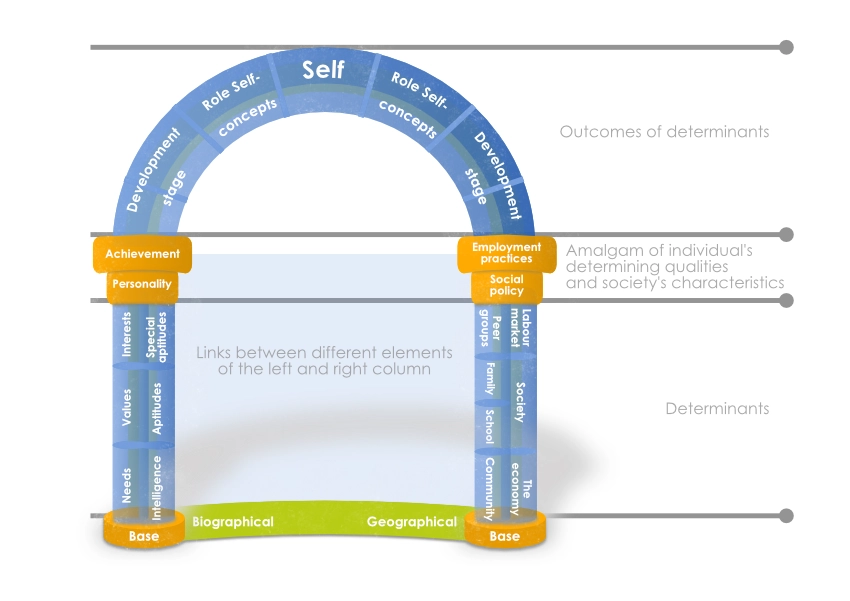
He indicates that the keystone of the Self is the element that makes the decisions, but that these are not value free but supported and influenced by both of the pillars and both sides of the archway. The individual synthesises the effects of the determinants in both pillars (Super, 1994, p.67). He further details that the left half of the arch is the development stage in childhood and adolescence and the right half of the arch is that of young adulthood and maturity (Gothard, 2001, p.19). Both of these go on to develop the key stone self. According to Gothard (2001), Super defined Social Learning Theory as the cement that binds the segments together.
How do we bring this into practice?
Super argues that ‘decision points’ occur both before as well as when taking up a new role; so, when giving up an old role and when making significant changes in the nature of an existing role (Super, 1980, p.291). Decisions can be either taken or not taken, changes can be made or not made, opportunities can be taken up or not. This is where we practitioners may contribute to a person’s life.
Super argues that the life-career rainbow has 2 major uses (Super, 1980, p.296):
-
- Teaching the concept of life-career, including the notion of life stages, life space and life style. This helps individuals see the interactive nature of the variety of roles constituting a career. It shows that self-actualisation can be achieved through a combination of different life roles.
- An aid to practice helping clients:
- analyse their own careers to date
- project them into the future as they have developed and as they might develop
For us, these points are interesting in that they further indicates how we can use the theory in practice. The life-career rainbow can literally be used as a model to show clients how the different roles they do, and may play in life, hang together, interact with each other, overlap or influence their decision making. At the same time, it can be used as a tool for them to imagine what their future may look and how or whether to take this into account in their planning, but also to help them imagine a different future than that dictated by their educational, social or familial environment.
Critique
Even though Super recognises, in his later work, the fluidity and flexibility of roles and how they interact, I think the world in the 21st century looks very different to that of the 1980s. My feeling is that even while recognising fluidity, his model has a tendency to be too rigid and not directly applicable to many people’s lives. In 1980, the world of work didn’t include the gig economy or zero hour contracts, pensioners needing to work beyond pension age to improve their financial situation, as well as the plethora of family structures we now see. I personally feel ‘determinant’ is too strong a word, especially with the flexibility in the educational system these days, though I recognise that there is an influence between roles and outcomes.
Paradoxically, I also feel to some extent that through his revision and in his attempt to bring his theory up to date, Super seems to have fragmented the elements of his paradigm to the extent that it indicates that the different elements that make up the different ‘life stages’ or ‘roles’ can be so flexible that it doesn’t make sense anymore.. up to a point. But I feel that’s slightly unfair in that his model still has real validity as a concept, and in practice.
What do you think?
- How does the rainbow relate to your life, maybe compared to that of your parents?
- How could you use this theory in practice with the client group(s) you work with?
- If you have a look again at Ginzberg’s developmental model, how does Super compare. What are the relative strengths and weaknesses of his theory compared to Ginzberg?
- Super’s developmental model is very different to what came before, such as Holland etc… How does it differ? What are the relative strengths and weaknesses between them?
- How applicable is Super’s theory to the situation in the 21st century?
- How does it far if you use Brown’s criteria?
Useful links
- www.careers.govt.nz/assets/pages/docs/career-theory-model-super.pdf
- www.careers.govt.nz/resources/career-practice/career-theory-models/supers-theory/
- https://runninginaforest.wordpress.com/2015/01/29/donald-supers-life-stage-rainbow-theory-theories-every-careers-adviser-should-know/
- https://warwick.ac.uk/fac/soc/ier/ngrf/effectiveguidance/improvingpractice/theory/traditional/#Developmental%20theories
- https://career.iresearchnet.com/career-development/supers-career-development-theory/
- www.mindtools.com/pages/article/newCDV_95.htm
References
- Gothard, W.P. (2001). Careers guidance in context. London ; Thousand Oaks, Calif.: Sage
- Super, D. E. (1994)’A Life Span, Life Space Perspective on Convergence’, in Savickas, M. and Robert William Lent (eds.) Convergence in Career Development Theories. Consulting Psychologists Press, p.63 – 74
- Super D. E., (1980). A Life-Span, Life-Space Approach to Career Development. Journal of Vocational Behavior. Vol. 16, 282-298