
Experiential Learning Cycle
David Kolb 1984





Table of Content
Definition
According to Kolb, “learning is the process whereby knowledge is created through the transformation of experience” (Kolb, 1984, p. 38). In Kolb’s experiential learning theory (learning through concrete experience and the absorption of abstract ideas, in turn through observation and experimentation), the learner goes through all 4 stages.
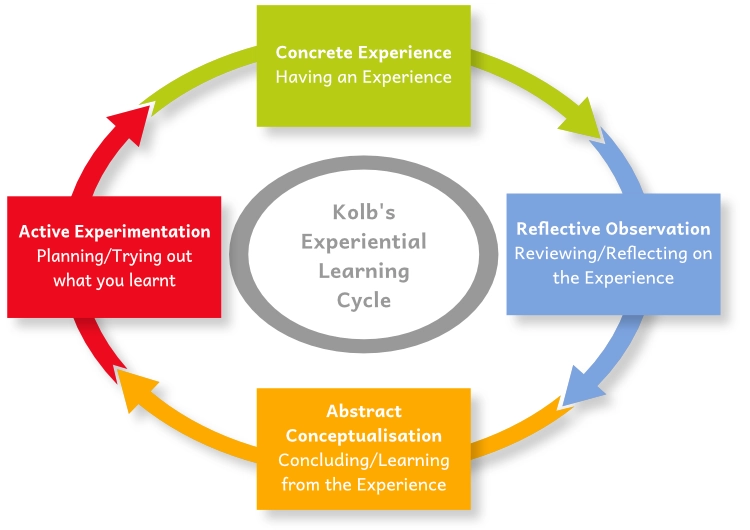
This is how it works:
- The learner goes through a new experience or has new perspective into an existing experience
- The learner then interprets and reflects on the new experience
- The individual learns from the experience through abstract conceptualisation – the learning experience is put into a new context
- The learner then applies this new idea or understanding to reality to test its validity
At this point it’s important to note that this theory can be used with both:
- Clients: you can for instance review the client’s experiences with them and use them as a tool for decision making, ‘unfreezing’ or moving forward.
- Professionals: as a reflection and CPD tool.
How can we put this into a career context?
1. With clients
In my view, this can happen in two different ways. It’s not just the 4 step experiential learning cycle Kolb developed but he also deduced 4 different learning styles. You can probably see that a career practitioner can use the above model, and illustration, to put the client’s learning in context and to use it as a model for progression and exploration.
For instance:
- You could support a client in contacting an employer to get some work experience in something they are interested in (step 1).
- The client reflects on this experience and you can support them in this during your next appointment (step 2).
- You can then help the client put their experience into a new context, relating it to what they know already (confirmation or challenging they still want to follow the same career path) (step 3).
- You can then support the client in doing further research into alternative careers following on from the conclusions based on the new learning, to see if this would fit the client better (step 4).
The second way Kolb’s work can be used is based on the learning styles he explored and developed in the early 1970s, before he developed his experiential learning inventory by the mid 1980s. Kolb argues that people, because of their hereditry conditions and their social environment and situation, gravitate towards some learning styles over others. He goes on to say that “each of us in a unique way develops a learning style that has some weak and strong points” (Kolb, 1974, p.5). It’s important to point out that Kolb doesn’t argue that we have only one learning style or a ‘preferred learning style’, he states that we gravitate towards a dominant learning style and that the other ones may to varying levels still be active and important.
- This can be relevant to career guidance because it could guide the practitioner in how to best work with a specific client.
- For the client it may help them understand themselves better and maybe find activities that tie in with their preferred learning style to explore options.
Additionally, the workplace is almost by definition a place of learning as well. Different work environments and careers will implicitly require different ways of learning.
Kolb’s theory visualised
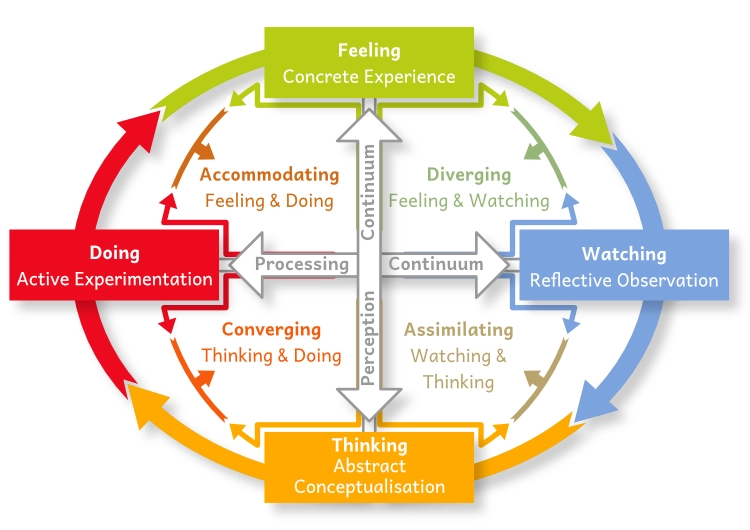
Take a bit of time and look at the model above. Think of a couple of clients this could be used with. How would they respond? You could even show them this model, or have them do a questionnaire. In fact, Kolb devised a learning style inventory (LSI) which may require some further research and practice, but which may be a bit too much for many of us to use within a career context. You can find this in Kolb, 1984, ‘Organizational psychology: an experiential approach to organizational behavior’, pages 32 onwards.
Where do you fit in yourself? Is it a good fit? Or is there a lot of overlap?
2. As a professional
This should be more straightforward in the sense that:
- We can start by planning an activity
- We can then put this into practice – concrete experience
- Followed by reflecting on the experience – reflective observation
- We can then draw conclusions and learn from the experience – abstract conceptualisation
- And put this into practice, which starts the cycle again – active experimentation.
The second way this works (second illustration above) works for us as professionals as well. We can use this to explore and reflect on our strengths and preferred learning style(s). This in itself is valuable in two ways.
- In my experience, our learning style can have an influence on how we work with clients and what we need to be aware of. If you strongly gravitate to one of the learning styles, then it’s very important to be aware of this so you don’t automatically and subconsciously assume the client has the same dominant learning style. It’s important to be actively aware of this bias and to explore the client’s dominant learning style to make the work we do more effective for the client.
- On the other hand, if we are conscious and aware of our own dominant learning style, whatever that is, we can use this to maximise our own reflection and aim the way we do CPD to fit in with this, making the most of what we take away. We can also work on the weaker learning styles and apply these to new learning to see if this provides a new perspective.
Critique
Kolb’s model makes good sense at first sight and consideration. What do you think?
For his learning model:
- Does it make sense to you? And more importantly, could you apply it?
- If you could, in what circumstances? Think of a couple of examples of clients you’ve worked with and see what you think?
- What if the client doesn’t want to reflect, doesn’t want to draw conclusions, or even test them out in practice? Is this just a model that works well in theory?
- Which techniques would you use or have to use to support the client in following Kolb’s model?
For Kolb’s theory on learning styles:
- Is this all there is? What about the other models out there, how does it compare?
- I’ve given you some examples of how this could be applied, above. What do you think? Is this useful? If so, when is it and when is it not?
- This looks a bit like the personality theories. Could you ascribe the same weaknesses and strengths to this? Have a look at one or two and see what you think.
At the same time, it may also be a good idea to test Kolbs theory to Brown’s criteria.
Useful Links
- https://learningfromexperience.com/downloads/research-library/the-kolb-learning-style-inventory-4-0.pdf
- www.simplypsychology.org/learning-kolb.html
- https://infed.org/mobi/david-a-kolb-on-experiential-learning/
- www.learning-theories.com/experiential-learning-kolb.html
- www.verywellmind.com/experiential-learning-2795154
- https://online.norwich.edu/academic-programs/resources/4-components-experiential-learning-cycle
- https://thetrainingthinking.com/en/the-four-stage-learning-cycle-by-david-kolb/
For interest, you can also find a copy of Kolb’s learning style questionnaire on the web in different places, so it would be good to have a look around, but be critical. There are a lot of ‘not so good’ tools on the web too. Bear in mind that the ones you find may be interpretations or weak copies.
References
- Kolb, D. A. (1984). Experiential learning: Experience as the source of learning and development (Vol. 1). Englewood Cliffs, NJ: Prentice-Hall
-
Kolb, D.A., Rubin, I.M. and McIntyre, J.M. (1984) Organizational psychology: An experiential approach to organizational behavior. Englewood Cliffs, N.J: Prentice-Hall.
- Kolb, D. A. (1976). The Learning Style Inventory: Technical Manual. Boston, MA: McBer.
-
Kolb, D.A.. and Goldman, M.B.. (1973) Toward a typology of learning styles and Learning Environments: An Investigation of the impact of learning styles and discipline demands on the academic performance, social adaptation and career choices of MIT Seniors. Cambridge, Mass.: Massachusetts Institute of Technology. Alfred P. Sloan School of Management.