
Expectancy Motivation Theory
Victor Vroom 1964





Table of Content
Definition
Vroom’s Expectancy Motivation Theory or Expectancy Theory suggests that individuals expect their positive performances to be followed by successes (Wigfield, 1994).
The theory further explains the motivational force is expectancy, times instrumentality, times valance. This implies that the higher these 3 values are, the higher motivation will be. Supporting clients in making decisions about effort, performance and rewards will have an effect, positive or negative, on their level of motivation.
Vroom’s theory is more located in organisational psychology, or in other words: in motivating employees, it needs a bit of translation for its use in career guidance.
- Expectancy: the belief that increased effort will lead to good performance. This can be linked to past experiences, perceived difficulty and self-confidence. The client will benefit of a high belief that effort will lead to good performance.
- Instrumentality: if I put in effort and good performance, this will lead to rewards. Instrumentality in this sense is the belief that there will be a reward when the criteria for effort and performance are met. The client will benefit from a belief that reward will follow if they put in effort and a good performance.
- Valence: the anticipated satisfaction or obtaining a goal or reward. If the client anticipates a good deal of satisfaction in obtaining a reward, this will have a positive influence.
If all of these are high, then the client will have motivation. If they are low, then motivation will be low or absent.
This can also be turned around. The client’s level of motivation depends on their belief in their level of expectancy, times their belief in their level of instrumentality times their level of valence.
So, if a client doesn’t believe their effort (expectancy) will lead to better performance (instrumentality), they they are likely not to anticipate a reward (valence) and their motivation will be low as a result.
Vroom’s Model graphic
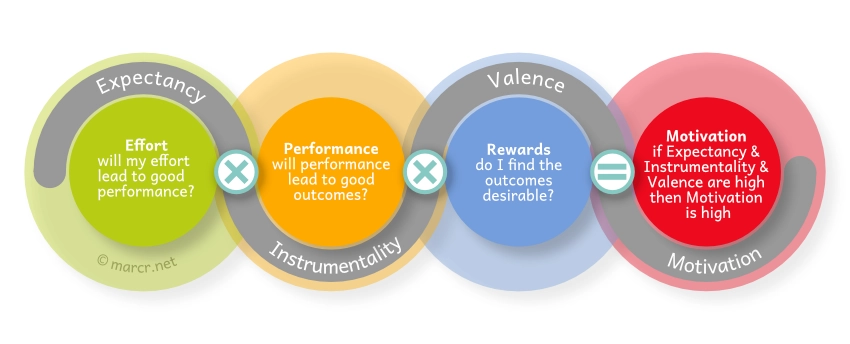
The illustration above shows flow (in visual format) between the different elements towards increased motivation. The level of each of the three elements: effort, performance and reward, will determine the level of motivation the client will have in exploring their ideas or in aiming for a particular career idea.
Expectancy Motivation Theory in practice
If we take the example at the top and reverse it, adapting it to our work with the client, then:
We can support the client in increasing their belief that their effort will lead to better (planning) performance and a worthwhile reward (a way forward in their career planning journey), thereby increasing their motivation, according to the theory.
I feel that the validity of this theory for career guidance, rather than for management, lies in the process.
For managers, offering the right rewards may trigger the right level of effort and performance, increasing motivation. This is difficult to translate in career guidance terms, although I made an effort to do this above.
Effort and performance in planning may or may not always offer the rewards the client is seeking, which may be a good thing, rather than negative. It may set them on a path that is even better and that they didn’t expect.
However, Vroom’s theory can be used in a different way in career guidance, coaching and counselling in that it can be an exploratory tool with the client. Let’s look at two examples:
- For instance: in exploring different career goals, Vroom’s theory can be used to explore the amount of effort the client is putting in and how this fulfils what they need to find out. Or effort can be related to the outcomes and whether they are desirable, after which the client can increase their effort and performance or decrease these and focus them somewhere else if the outcomes are not desirable.
- Another way to use Vroom’s theory in career coaching, guidance and counselling can be by starting with their level of motivation. You can then explore where their (low) level of motivation originates. Are the rewards not desirable enough? And if so, what rewards would be desirable and increase motivation? How much effort are they putting in and is that why they don’t see the rewards they were hoping? Is their effort being applied efficiently or do they need to refocus to increase performance?
Critique
Although it requires some creative thinking, the building blocks of the level of motivation and how they related to each other, are there, within Vroom’s theory. This is not a model, which can be a good thing in that you can then use your own creativity to make this theory work for you. Just like all theories of motivation in my view, applying this theory may not work with all clients but it’s an excellent tool to have in your toolbox.
How do you feel?
- Do you feel this is generally applicable with all clients lacking motivation?
- Vroom takes a very different approach to Maslow. What is the difference, can you describe it?
- Two Factor Theory is also based in business, but the two have a very different starting point. Compare the foundation of Two Factor Theory and Expectancy Motivation Theory. Is one easier to apply with your clients? Why?
- What are the fundamental differences between Vroom’s theory and Motivational Interviewing? Could you make a list of both to compare?
- Again, here too, have a look at how Expectancy Motivation Theory scores in Brown’s eyes.
To explore these questions, also have a look at the links below.
Links, references and suggested further reading
- https://www.yourcoach.be/en/employee-motivation-theories/vroom-expectancy-motivation-theory.php accessed 19/10/2019
- https://positivepsychology.com/expectancy-theory/ accessed 21/03/2026
- https://www.tsw.co.uk/blog/leadership-and-management/vrooms-expectancy-theory/ accessed 21/03/2026