
Community Interaction Theory
Bill Law 1981 & 1986






Table of Content
Introduction
With his Community Interaction Theory, Bill Law offers a critique of Ken Roberts opportunity structure theory in that he argues that social structure doesn’t dictate what opportunities are open to us but it influences our thinking and the story we tell about our career journey, both past and future. This brings him into close proximity to the narrative approach and indeed, in 2008 Law will go on to develop the idea of story boarding in career guidance.
Where does it fit?
Community Interaction Theory sits in between the structural approach and approaches strongly based on psychology. As mentioned above, this theory is also closely linked to the narrative approach in that it focuses on narratives within an individual client’s social environment and how it influences their thinking and actions.
Comparison of Opportunity Structure Theory and Community Interaction Theory
Let’s illustrate this with an example, the same example, for both theories. Let’s see how this works within the context of gender/biological sex, as this is nice and clear. Let’s challenge or use the stereotype and take the hypothetical and exaggerated (for clarity) example of Emily, a female client who wants to be a car mechanic.
In Ken Roberts’ Opportunity Structure Theory…
…this would be conceptualised as follows: imagine that in this example, no one has ever heard of a female car mechanic and the courses that are available at local colleges don’t take girls. Also, Emily can’t get an apprenticeship because all the employers only have male changing rooms and male only toilets. No employer has ever taken on anyone female and customers wouldn’t trust their car being maintained by a female car mechanic and go elsewhere. Unfortunately, this is not far from reality for many…
How this worked: In this case, the structure, the facilities, for Emily to become a car mechanic aren’t there, either in education or in the workplace. The society she lives in has such strict rules about who can be a car mechanic and who can’t, that becoming one is not an immediate possibility. So, however much Emily wants to be a car mechanic, the very gendered societal structures in place are an obstacle of such magnitude that Emily is likely, or even forced to choose another career path. The social structure she lives in blocks her off from her preferred career path.
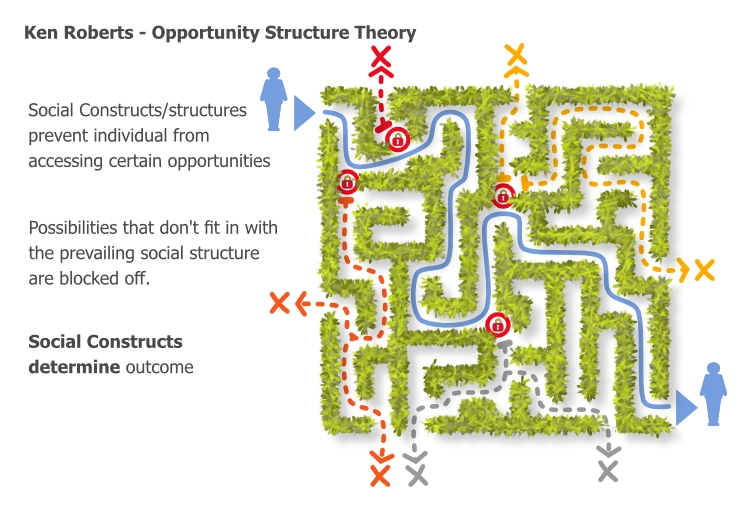
Let’s see how this would be different, viewed from the perspective of Bill Laws Community Interaction theory:
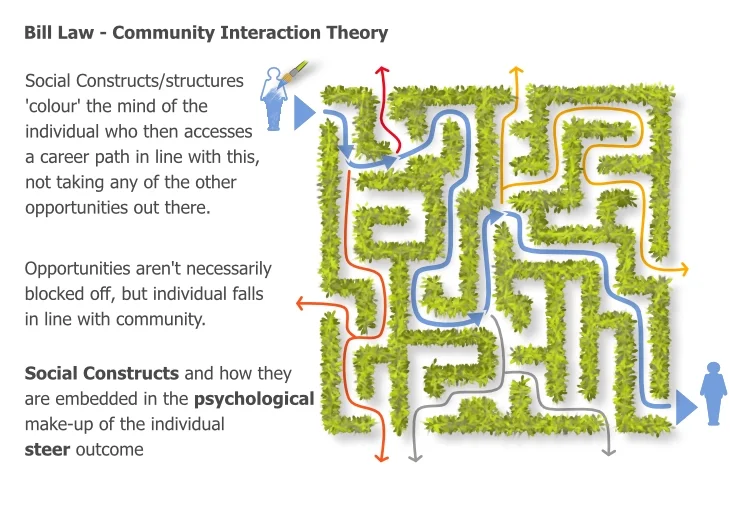
In principle Emily would be able to do a course in car mechanics and eventually find a job. However, from a very young age she has never met a female car mechanic, nor been presented with the possibility of becoming one. Even if she then decides that she wants to train to be a car mechanic, her parents talk to her to make sure she’s making the right choice as being a car mechanic is a ‘man’s job’. Equally, when she tells her friends most of them laugh at her and some even end their friendship with her, so she decides to become a nursery nurse instead.
How this worked: Even though Emily can become a car mechanic, from a young age society around her ‘colours’ her thinking in a way that causes there to be less of a possibility of her even thinking about being a car mechanic and doing the necessary courses to get there. Even if she does, and even though the possibility is there in principle, the social structure around Emily will try and steer her away from this option through (possibly) well-intended but biased advice that is rooted in the social structure, rather than in Emily’s best interests, through derision, through loss of friendships, etc…
Please move the slider in the image below to compare…
How this looks

5 modes of influence
According to Law there are 5 modes in which influence can occur between a client and the social community they live in:
- Expectations – what is acceptable in the social circle an individual moves around in?
- Feedback – responses from others around the individual
- Support – in developing skills, expectations and planning that fits in with the social environment of the individual
- Modelling – role models and influential people around the individual and their level of identification with these
- Information – about options and opportunities. How much is this filtered by the individual’s social surroundings?
These influences are not necessarily a hindrance for the self-realisation of the individual’s interests and potential. They can have a positive influence as well but it’s important to recognise these influences in oneself and clients to provide non-judgmental, bias free (if such a thing exists) support.
How can we use this in our practice?
In my practice I often catch myself thinking “where does that come from” in response to something a client says that either fits too well with their perceived social background and not at all with what they say they prefer, or are aiming for. I bet all of us have been in a similar situation.
The 5 modes above give us a good structure by which to explore and question this with the client more routinely. They don’t offer so much as a technique, but more a framework of understanding and exploration.
- What are the client’s expectations and how do they fit in with those of the people surrounding them?
- What have people said about their ideas and what they ‘should do’?
- What does their support network look like and which skills have they been able to develop through their contact with parents, friends, teachers, wider family etc…
- What are their role models (see the narrative approach for how this links Community Interaction Theory with the narrative approach) and what are the values they picked up from them. How do these link with their plans for their next step?
- What information do they have about their options and ideas and where has that come from? Who told them about what an idea entails and is this correct for the client?
Additional questions could be:
- How much is the client working from within their comfort zone, and is this justified (because of an anxiety condition for instance)?
- What has the client explored outside of their comfort zone, outside of what other people have suggested and outside of what their parents’ career position and background is?
- How does their career idea link to what their parents do, especially if your client is a young person?
- How much ‘contact’ have they had with careers outside of their comfort zone and to what extent?
Critique
Community Interaction Theory obviously has a lot of very important points to make about where our ideas come from and whether we really operate as independent individuals. It also does only imply, and even then not very openly, another influence on the client related to this: our own biases and our own social context, background and history. System Theory illustrates this really well if you look at the last illustration on its page on this website. I would argue there is no way one can ever be completely bias free, whether as a professional in working with clients, or in our own minds. Most of our baiases take place in our subconscious (does a fish realise it swims in water?) and the best we can do is to bring them into our awareness through regular reflection and conistently questioning where our own thoughts and ideas come from, especially within our practice, but also in our personal lives.
In my view, what is also missing from this theory, is the factor of personal agency and societal agency, through the media, trends etc… for change. We are all noticing tremendous changes in society and how we perceive ‘the other’, as well as our social habits. Within our living history, it was not uncommon to be able to smoke in hospitals and on planes and trains (!!). I can also see the difference within my own family. My own parents still refer to ‘female coach drivers’ rather than just drivers and I have to be very conscious of the influence of their socio-cultural context on me and how I think and perceive the world (of work) around me. In a way we are quite lucky in our profession for having a strong prompt to do the work in acquiring that awareness of our (subconscious) biases and (hopefully) be supported in this by the people that surround us in our work. We can then also actively be a support to those people who are interested in careers that are not stereotypical witin their social environment.
However, as mentioned, we can never fully get rid of those biases. To illustrate this, using gender and biological sex as the background for this excercise: if you can, exoplore how you think along typical gender lines. How do we have expectations of people of the opposite sex in what they say and do, or in other words, how are your ideas of ‘woman’ and ‘man’ coloured by your experiences, background, etc… and how often have you thought “of course, typical man/woman”?
More linked directly to Law’s theory; what do you think are other strengths of this theory for you, your clients and your practice?
There are also questions to be explored:
- Can you think of other influences on a client’s life and planning? In regard to this, what else or who else do they come into contact with outside their community? Within that, there are the media, globalisation, social media, networks outside their immediate environment etc…
- How much time does your organisation or you allow for exploring this? And linked to this, what if a lot of other areas to explore come to the surface because you are exploring the questions above, and more, with the client?
- Is it always possible to look at all five factors? Or can you only apply a partial approach because of time and/or resources?
- How would clients respond to you suggesting their ideas are (strongly) influenced by their parents, for instance? How would the client’s parents react or respond? How would you handle their response, positive or negative? How can you mediate, to the benefit of the client?
- What effect does this theory have on your own biases you take into your consultations with clients? Would you be more aware? Or is this a minefield with no way out?
Useful links
- www.hihohiho.com/ and www.hihohiho.com/memory/cafcit.pdf
- https://careersintheory.wordpress.com/2009/12/17/community-interaction/
- https://runninginaforest.wordpress.com/2015/06/06/bill-laws-community-interaction-theory-_-theories-every-careers-adviser-should-know/
- https://careersintheory.files.wordpress.com/2009/12/communityinteractions.pdf
- https://warwick.ac.uk/fac/soc/ier/ngrf/effectiveguidance/improvingpractice/theory/traditional/#Community%20interaction%20theory
- https://app.slidebean.com/p/0i1hGlkyeC/Social-Theory-Bill-Law-Community-Interaction-Theory
Reference
- The Counselling Approach to Careers Guidance, Ali L. & Graham B., 2000, Routledge, Hove, Sussex
Video
This is an interesting video with a cultural slant to the theory: